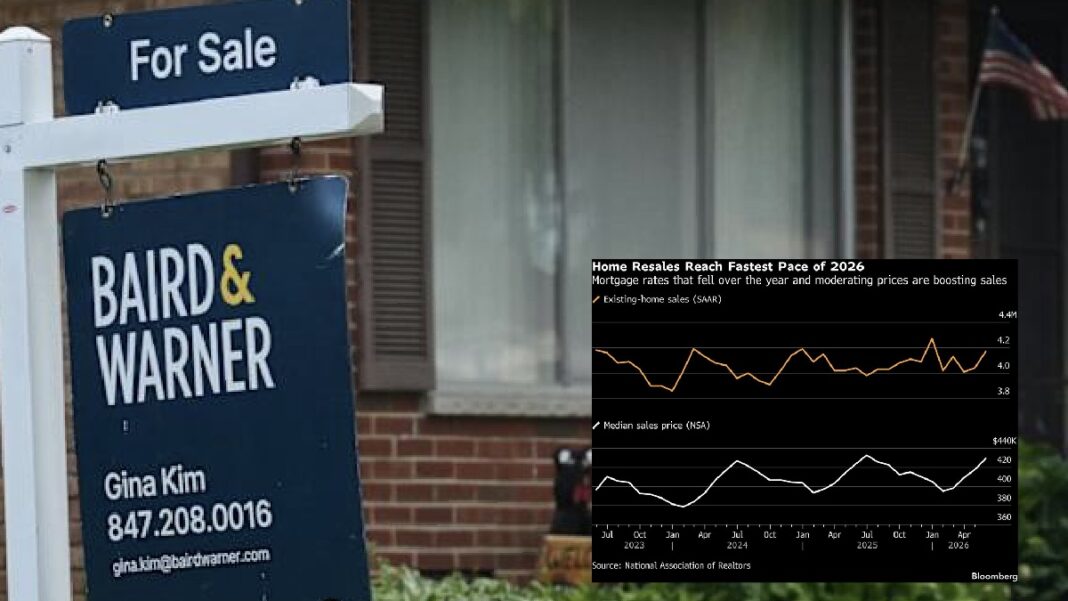
US Home Sales Hit Fastest Pace Since December
Sales of existing homes in the United States rose sharply in May, marking the strongest pace since December and signaling a recovery in buyer demand after a slow start to the spring housing season.
According to data released Tuesday by the National Association of Realtors (NAR), existing-home sales increased 3.2% from April to a seasonally adjusted annual rate of 4.17 million units. The figure also represented a 3.2% increase compared with May 2024 and exceeded economists’ expectations of roughly 4.07 million units.
Regional performance was mixed. Sales rose year over year across the Midwest, South, and West, while the Northeast recorded a decline.
Despite the improvement, the housing market remains well below historical norms. Existing-home sales have hovered near an annual pace of 4 million units since 2023, compared with a long-term average closer to 5.2 million.
Prices Continue to Reach New Highs
Home prices continued their upward trend in May. The median U.S. existing-home sales price climbed 1.3% from a year earlier to $429,300, the highest May price on record since NAR began tracking the data in 1999. This marks the 35th consecutive month of annual price growth.
The housing market has struggled since 2022, when mortgage rates began rising from pandemic-era lows. Last year’s existing-home sales were effectively unchanged and remained near a 30-year low. Sales activity has stayed subdued through much of 2025, including a flat reading in April.
Affordability Challenges Persist
Years of rapidly rising home prices, combined with elevated borrowing costs, have continued to challenge prospective buyers. The market is also constrained by a longstanding shortage of homes for sale, partly due to years of insufficient new-home construction.
Homes sold in May were generally placed under contract during March and April, when average 30-year mortgage rates ranged from about 6% to 6.46%, according to Freddie Mac. Mortgage rates averaged 6.48% last week, down from 6.85% a year earlier.
Geopolitical Tensions Add Pressure to Rates
Although mortgage rates remain lower than a year ago, they have moved higher in recent weeks. Analysts point to disruptions in global energy markets linked to the conflict involving Iran, which has contributed to higher oil prices and rising long-term bond yields. Because mortgage rates are closely tied to those yields, borrowing costs have also increased.
First-Time Buyers Gain Ground
Despite affordability concerns, first-time buyers accounted for 35% of all home purchases in May, the largest share since June 2020. Historically, first-time buyers represent about 40% of the market.
Buyers also benefited from a modest increase in available inventory. At the end of May, there were 1.55 million unsold homes on the market, up 3.3% from April and 0.6% from a year earlier. However, inventory remains below the roughly 2 million homes typically available before the COVID-19 pandemic.
At the current sales pace, the available inventory represents a 4.5-month supply of homes. Housing economists generally consider a 5- to 6-month supply to indicate a balanced market between buyers and sellers.
Overall, May’s stronger sales figures suggest renewed demand in the housing market, but affordability pressures, elevated mortgage rates, and limited inventory continue to pose challenges for a full recovery.Sales of existing homes in the United States rose sharply in May, marking the strongest pace since December and signaling a recovery in buyer demand after a slow start to the spring housing season.
According to data released Tuesday by the National Association of Realtors (NAR), existing-home sales increased 3.2% from April to a seasonally adjusted annual rate of 4.17 million units. The figure also represented a 3.2% increase compared with May 2024 and exceeded economists’ expectations of roughly 4.07 million units.
Regional performance was mixed. Sales rose year over year across the Midwest, South, and West, while the Northeast recorded a decline.
Despite the improvement, the housing market remains well below historical norms. Existing-home sales have hovered near an annual pace of 4 million units since 2023, compared with a long-term average closer to 5.2 million.
Prices Continue to Reach New Highs
Home prices continued their upward trend in May. The median U.S. existing-home sales price climbed 1.3% from a year earlier to $429,300, the highest May price on record since NAR began tracking the data in 1999. This marks the 35th consecutive month of annual price growth.
The housing market has struggled since 2022, when mortgage rates began rising from pandemic-era lows. Last year’s existing-home sales were effectively unchanged and remained near a 30-year low. Sales activity has stayed subdued through much of 2025, including a flat reading in April.
Affordability Challenges Persist
Years of rapidly rising home prices, combined with elevated borrowing costs, have continued to challenge prospective buyers. The market is also constrained by a longstanding shortage of homes for sale, partly due to years of insufficient new-home construction.
Homes sold in May were generally placed under contract during March and April, when average 30-year mortgage rates ranged from about 6% to 6.46%, according to Freddie Mac. Mortgage rates averaged 6.48% last week, down from 6.85% a year earlier.
Geopolitical Tensions Add Pressure to Rates
Although mortgage rates remain lower than a year ago, they have moved higher in recent weeks. Analysts point to disruptions in global energy markets linked to the conflict involving Iran, which has contributed to higher oil prices and rising long-term bond yields. Because mortgage rates are closely tied to those yields, borrowing costs have also increased.
First-Time Buyers Gain Ground
Despite affordability concerns, first-time buyers accounted for 35% of all home purchases in May, the largest share since June 2020. Historically, first-time buyers represent about 40% of the market.
Buyers also benefited from a modest increase in available inventory. At the end of May, there were 1.55 million unsold homes on the market, up 3.3% from April and 0.6% from a year earlier. However, inventory remains below the roughly 2 million homes typically available before the COVID-19 pandemic.
At the current sales pace, the available inventory represents a 4.5-month supply of homes. Housing economists generally consider a 5- to 6-month supply to indicate a balanced market between buyers and sellers.
Overall, May’s stronger sales figures suggest renewed demand in the housing market, but affordability pressures, elevated mortgage rates, and limited inventory continue to pose challenges for a full recovery.