Britain Faces Risk of Food Unrest
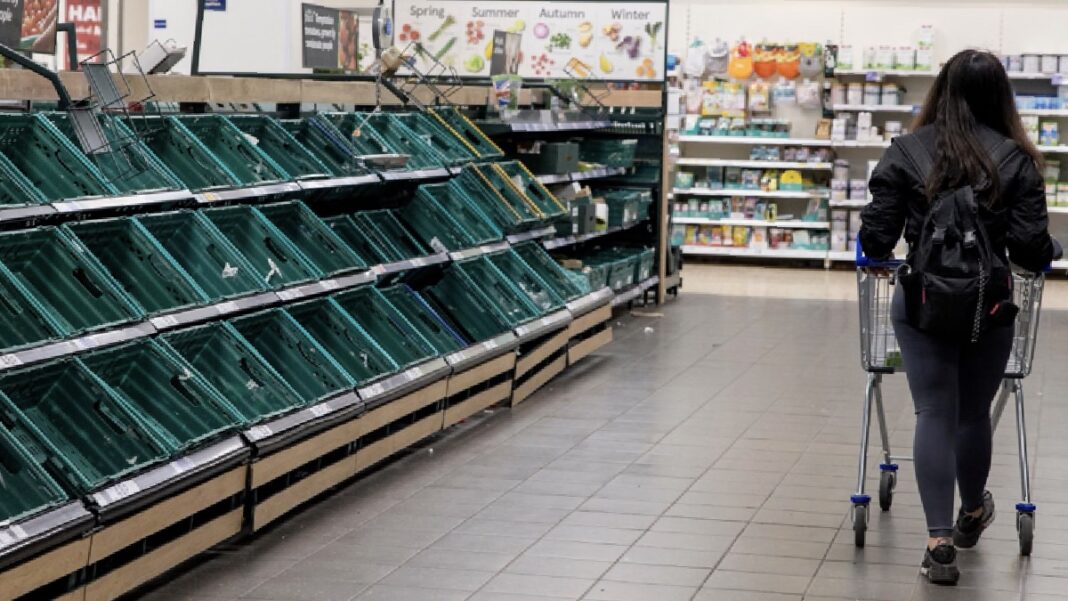
The UK could face social unrest — including potential food riots — if a major disruption hits its already fragile food system, according to a group of leading food security experts. They warn that long-standing weaknesses have turned the system into a “tinderbox,” vulnerable to being ignited by a single serious shock.
More than 30 specialists from academia, industry and government contributed to the new analysis, published in the journal Sustainability. They identified chronic structural problems that have steadily weakened the country’s food resilience. Among the key concerns are the climate crisis, persistently low household incomes, shortcomings in agricultural policy, and heavy reliance on tightly timed supply chains that leave little room for disruption.
Researchers then examined which types of shocks could trigger a full-scale food crisis. Extreme weather events, cyber-attacks, and international conflict were judged to pose the highest risk. Such disruptions could interrupt supply chains and drive up food prices, increasing pressure on already struggling households. In severe scenarios, this could fuel black-market sales of unsafe food, heightened social tensions, and potentially civil disorder.
Previous related research published in 2023 found that 80% of surveyed food experts believed large-scale violence linked to a food crisis was possible within the next 50 years. Forty percent considered it plausible within the next decade. One modeled scenario envisioned more than 30,000 people suffering violent injuries over a single year due to food-related protests or riots.
The study notes that several warning signs have already appeared. Cyber-attacks targeted major UK supermarket chains in 2025, while overseas droughts and Russia’s invasion of Ukraine have contributed to rising global food prices. At the same time, food insecurity remains widespread domestically, with around one in seven UK households affected in 2025, according to the Food Foundation.
Professor Sarah Bridle of the University of York, who led the analysis, said that food system stability must be treated as a national security issue. While shocks cannot always be prevented, she argued that stronger resilience can stop disruptions from escalating into crises. Understanding how the food system might behave under extreme strain is essential to avoiding worst-case outcomes.
Professor Aled Jones of Anglia Ruskin University echoed the call for long-term planning, warning that the UK is not shielded from severe disruptions and must prepare accordingly.
In response, a government spokesperson emphasized that food security remains a national priority. Officials pointed to strong domestic production, stable trade routes, and significant investment in agricultural technology, climate-resilient crops, and regulatory reform aimed at boosting output.
Concerns about food insecurity and instability are not confined to the UK. Álvaro Lario, president of the International Fund for Agricultural Development, recently warned that fragile food systems represent a growing threat to global stability.
The researchers highlighted additional structural risks, including the concentration of global food production in a small number of major exporting countries such as the United States, Brazil, and Russia. Critical supply-chain bottlenecks — including routes like the Suez Canal — add further vulnerability. Increasing digitization of food logistics also raises exposure to cyber threats.
Social dynamics were also identified as crucial. The report suggests that a food crisis could be intensified by public distrust in government and feelings of despair among those already struggling to afford adequate food.
Dominic Watters, a researcher involved in the study who has lived experience of food poverty, emphasized that unrest stems not only from hunger itself but from loss of dignity and voice. He called for affected communities to be directly involved in designing responses to food insecurity.
To reduce risks, the study recommends building more resilient and diversified domestic food production, expanding regenerative agricultural practices to lower crop-failure risks, strengthening coordination between government and businesses, and introducing emergency cash support for vulnerable households. It also calls for the creation of a national preparedness forum that includes marginalized groups.
Experts conclude that while the UK’s food system has withstood recent shocks, its underlying vulnerabilities mean that without decisive action, a future crisis could have serious social consequences.
Source: The Guardian