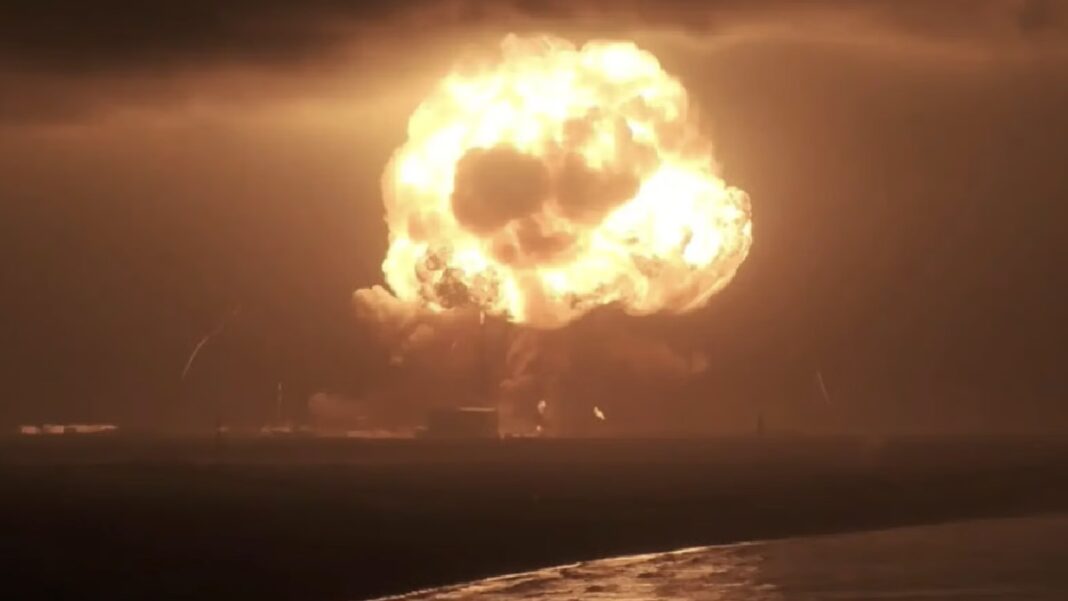
Cape Canaveral Explosion Triggers Review
Blue Origin is investigating a major explosion involving its New Glenn rocket during a static fire test at Cape Canaveral, an incident that could affect upcoming lunar missions tied to Nasa’s Artemis program.
The explosion occurred Thursday evening at Launch Complex 36, sending shockwaves across Florida’s Space Coast and creating a fiery glow visible as far north as South Carolina. Videos shared online, including footage from aerospace outlet NSF, captured a large plume of fire rising from the launch site. Residents in nearby communities such as Cape Canaveral and Cocoa Beach reported shaking homes and turned to social media seeking answers.
Emergency officials said there was no danger to the public from fumes or other hazards, though flames reportedly continued burning at the launch site for more than two hours.
Blue Origin described the incident as “an anomaly” and said an investigation is underway to determine the cause. Founder Jeff Bezos acknowledged the setback in a post on X, saying it was too early to identify the root cause but emphasizing that the company would rebuild and continue its efforts.
Nasa administrator Jared Isaacman said the agency would conduct a full review of how the incident may affect mission schedules, including the Artemis program and plans for a future lunar base.
“Spaceflight is unforgiving, and developing new heavy-lift launch capability is extraordinarily difficult,” Isaacman wrote, adding that Nasa would support a thorough investigation and evaluate any near-term mission impacts.
The setback comes at a crucial time for Blue Origin, which is competing with Elon Musk’s SpaceX for key roles in Nasa’s lunar exploration plans. Earlier this week, Nasa announced Blue Origin had secured a contract to launch the first of three planned missions aimed at beginning construction of a proposed $20 billion moon base.
Blue Origin is also competing with SpaceX to provide a lunar lander for Artemis IV, currently targeted for 2028. That mission is expected to mark humanity’s return to the moon for the first time since 1972.
The company has faced several challenges in recent months. A payload from New Glenn’s third flight reportedly reached an incorrect orbit last month, leading to a temporary grounding by the Federal Aviation Administration (FAA). The static fire test that ended in Thursday’s explosion was the first since the FAA approved the rocket’s return to flight last week. The agency has not yet commented on whether another investigation will follow.
Both Blue Origin and SpaceX have expanded operations near Cape Canaveral, constructing major facilities to support Nasa crewed and cargo missions.
Under current plans, Artemis III, expected in 2027, will test both Blue Origin’s Blue Moon lander and SpaceX’s Starship Human Landing System to determine which vehicle will carry Artemis IV astronauts from the Orion capsule to the lunar surface.
Musk reacted to the explosion on X, describing the event as “most unfortunate” and adding: “Rockets are hard.”
Beyond government contracts, Blue Origin continues to pursue commercial space tourism. The company drew widespread attention in April after launching an all-female celebrity crew that included broadcaster Gayle King and singer Katy Perry.
The incident now places additional pressure on Blue Origin as it seeks to balance commercial ambitions with increasingly important partnerships in Nasa’s return-to-the-moon strategy.
The Associated Press contributed reporting