Gaza Plan Faces Delay at DC Peace Summit Stagnates
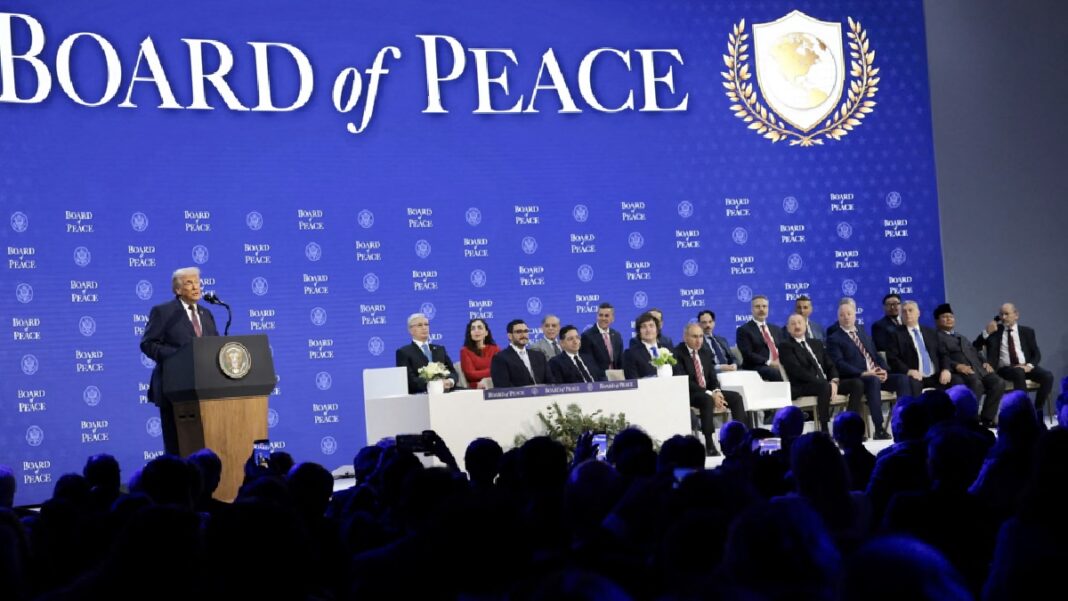
Dozens of international leaders and national delegations are gathering in Washington DC for the inaugural summit of President Donald Trump’s newly established Board of Peace, an initiative aimed initially at rebuilding Gaza but now broadened to address wider global conflicts.
The meeting, held at the renamed Donald J Trump Institute of Peace, is expected to focus heavily on fundraising. Trump announced on social media that participating countries have pledged more than $5 billion for Gaza’s reconstruction. He also claimed that member states committed thousands of personnel to an International Stabilization Force (ISF) and local policing efforts to help maintain security in the territory.
European Allies Decline Participation
Despite the administration’s optimistic tone, the summit opens under considerable skepticism. Several major European allies have declined to join the board, raising concerns about its funding transparency and political mandate.
Ursula von der Leyen, President of the European Commission, turned down her invitation. Leaders from the United Kingdom, Germany, and France have also opted out.
The initiative faced another setback when Pope Leo XIV announced that the Vatican would not participate. Cardinal Pietro Parolin, the Vatican’s top diplomat, emphasized that international crisis management should primarily remain under the authority of the United Nations, suggesting concerns that the Board of Peace could sideline established global institutions.
Meanwhile, Trump reportedly rescinded an invitation to Canadian Prime Minister Mark Carney after Carney delivered a critical speech at the World Economic Forum in Davos.
Middle Eastern Presence, Political Calculations
While European leaders are absent, the summit will include delegations from Israel, the United Arab Emirates, Saudi Arabia, Turkey, Jordan, and Qatar. Several other participating countries—such as Argentina, Paraguay, Hungary, and Kazakhstan—have limited direct involvement in the Gaza conflict but are viewed as strengthening ties with Washington by joining the initiative.
Israeli Prime Minister Benjamin Netanyahu, who previously expressed support for the plan, will not attend. Instead, Foreign Minister Gideon Saar will represent Israel. Analysts suggest Netanyahu’s absence reflects domestic political pressures, especially during an election year, as cooperation with regional actors like Qatar or Turkey may carry political risks at home.
Stalled 100-Day Gaza Plan
The Board of Peace is closely linked to a 100-day peace and recovery plan unveiled in Davos by Jared Kushner, Trump’s son-in-law. Nearly a month after its launch, however, progress remains limited.
The National Committee for the Administration of Gaza (NCAG), a technocratic body established under the plan, is currently based in Cairo. Its members have expressed frustration over unclear authority, limited administrative powers, and uncertainty regarding funding and operational responsibilities.
Nickolay Mladenov, appointed as the Board’s high representative for Gaza, has maintained a low public profile, and implementation details remain vague. According to Israeli peace activist Gershon Baskin, even basic questions—such as the committee’s budget and chain of command—remain unresolved.
International Stabilization Force in Question
Plans for an International Stabilization Force to support Palestinian police have shown minimal progress. Indonesia has reportedly offered 8,000 troops, and preparations for barracks in Gaza are underway. However, diplomats warn that without clear agreements on Hamas disarmament and Israeli Defense Forces withdrawal, the mission could fail before it begins.
Humanitarian Crisis Persists
On the ground, conditions in Gaza remain dire. Aid deliveries are severely restricted, and the list of banned “dual-use” materials—including many essential construction supplies—has not been eased. Continued Israeli military operations and demolitions further complicate reconstruction efforts.
Humanitarian officials warn that without rapid, visible improvements—particularly in civilian protection and aid access—the Board of Peace risks losing credibility quickly.
Uncertain Outlook
Experts argue that the initiative faces significant obstacles, including unresolved governance questions, security arrangements, and stalled negotiations between Israel and Hamas. While fundraising pledges may appear impressive, translating commitments into meaningful progress will require coordination, political compromise, and sustained international support.
As the summit convenes in Washington, the success of Trump’s latest diplomatic initiative will ultimately be judged not by announcements, but by measurable improvements in Gaza’s humanitarian and political landscape.